That gorgeous villa listing looks perfect until you arrive and discover the “pool” is a two-meter plunge basin, unheated in October, or visible from the neighbor’s upstairs terrace. Pool photos in villa listings often hide heated-versus-unheated surprises, tiny plunge pools and overlooked safety issues, so how do you book the right private villa pool? The answer is knowing exactly which questions to ask before you pay the deposit.
This guide walks you through the essentials, one by one. We’ll cover how to match pool size, depth and type to your group, how to make sure the water will actually be swimmable in your travel month, and how to judge privacy and positioning from photos and floor plans. You’ll also find practical advice on safety features for children and non-swimmers, cleaning schedules and house rules, the true cost of a private villa pool, and a short checklist for booking with confidence. A few minutes of checking now can save a disappointing stay later.
Pool Size, Depth and Type: Matching the Pool to Your Group
Pool photos are notoriously flattering. A wide-angle lens can make a 3-meter plunge pool look like a resort lagoon, so never rely on images alone. Always check the listed dimensions in the villa description, and if they’re missing, message the host before booking. A quick question about length, width and depth takes minutes and can save you from a week of disappointment. It also helps to ask for a photo taken from the pool’s edge rather than from above, which gives a far more honest sense of scale. The right size depends entirely on what your group wants to do in the water, and it’s the first thing to settle before you compare prices.
Depth matters just as much, especially with children of different ages or older relatives who aren’t confident swimmers. A pool that’s uniformly deep may look impressive but can leave younger kids standing on tiptoe or clinging to the edge. Ask for the exact shallow and deep measurements rather than a vague “family-friendly” label, and confirm where the shallow shelf begins and ends. Beyond size and depth, a few specific details deserve their own check:
- Plunge pools under 4 m are fine for cooling off and letting small children splash, but there’s no room to swim a stroke, so they suit short stays and hot afternoons rather than active swimmers.
- Lap swimmers need 10 m or more of uninterrupted length; anything shorter means constant turns, so fitness-focused guests should confirm this figure in writing.
- A depth range of roughly 1.0-1.5 m is the sweet spot for families with mixed ages, deep enough for adults to swim comfortably and shallow enough for most children to stand.
- Shared versus truly private is a crucial distinction: some “private pool” villas have units on the same grounds sharing one pool, so ask directly whether the pool is exclusive to your booking.
- Infinity and rooftop pools often have shallower sections or restricted swim zones for structural and safety reasons, so ask which areas are actually usable.
Heating and Season: Will the Private Villa Pool Actually Be Swimable?
A beautiful pool that’s too cold to enter is one of the most common villa disappointments. The key issue is that “heated” means nothing on its own. A heater that raises the water a few degrees may be plenty in June and useless in April, and some owners switch heating off outside peak months entirely. The single most useful question you can ask a host is for the pool’s average water temperature in your specific travel month, not just whether a heater exists.
When an unheated pool is enough
If you’re traveling to a Mediterranean destination, an unheated pool is generally comfortable from May through September, when sun does the work for free. Outside that window, or in cooler regions, you’ll want heating, and that’s where the details matter. Heating typically adds $30-$100 per night, and it’s sometimes an optional extra you must actively request rather than a service included by default. Ask whether the heater runs continuously or only on set hours, and who controls it.
Timing your booking
Heated pools are in high demand for summer, so for peak season travel with a heated pool, plan to book 4-6 months ahead. That lead time gives you the best choice of villas and avoids settling for a property whose heating setup doesn’t match your needs. Get the heating arrangement confirmed in writing as part of your booking, including any nightly cost, so there are no surprises on arrival.
Privacy and Positioning
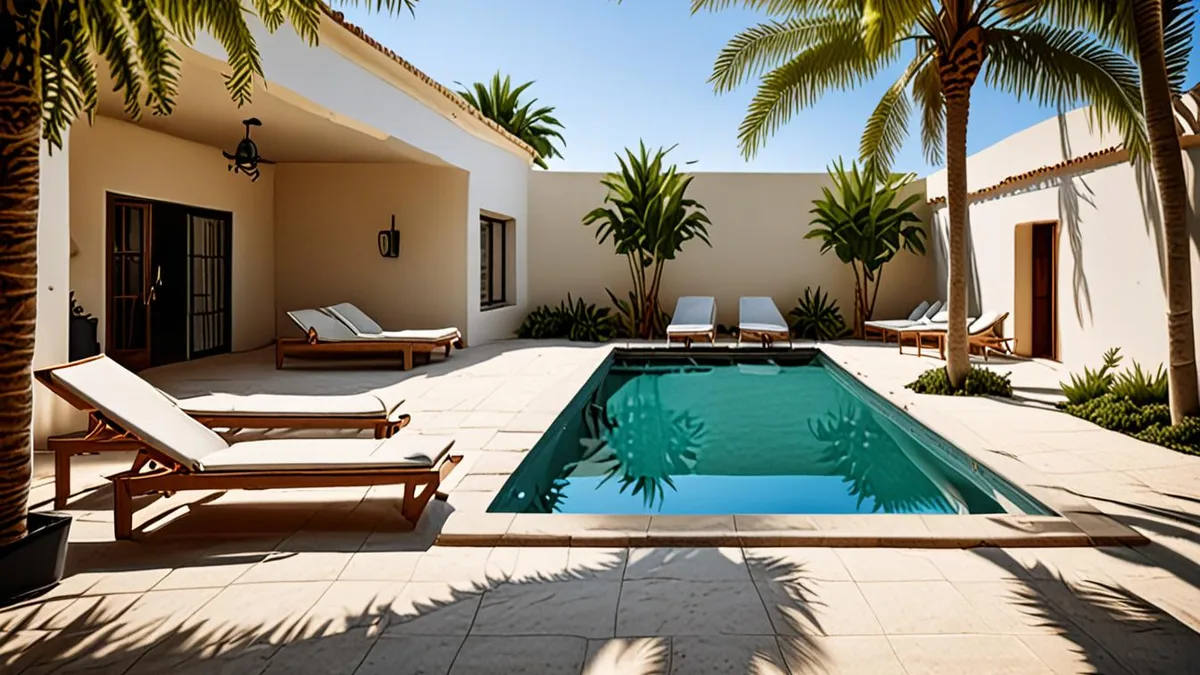
A pool can be perfectly sized, perfectly warm and still disappointing if it feels exposed. Privacy is one of those things that’s hard to fix after booking and easy to check before. Start by studying the listing photos with a critical eye: look at what’s visible in the background of terrace shots, and study the floor plans for the villa’s orientation relative to neighboring properties. Zoom in on upper windows, and imagine standing in the pool looking out.
Orientation also shapes your experience day to day. A south-facing pool gets the most sun hours across the day, which matters if you’re traveling in spring or autumn when warmth is precious. Walled courtyards work differently: they sacrifice some open views but offer shade during midday heat and protection from wind, which can make a pool usable on breezy coastal days when an exposed one feels chilly. Beyond what you can see, a few questions are worth asking directly:
- Shared access paths: ask whether any walkway to another unit, the beach or a public area passes your pool terrace, since even occasional foot traffic changes the feel of the space.
- Adjacent terraces: neighboring villas or the owner’s own terrace may sit at a higher level, so ask whether any overlooking terrace is occupied during your dates.
- Road and venue noise: nearby roads or beach clubs can carry sound well into the evening, so ask about noise levels at night specifically, not just during the day.
- Equipment placement: pool pumps and filtration systems can hum constantly; ask where the equipment sits relative to bedrooms and whether it runs overnight.
Safety Features for Children and Non-Swimmers
A private pool is wonderful with kids, but only if you plan for safety before you pay the deposit. The most common child-safety features offered by villa owners are pool fences and alarms, so request them at the booking stage rather than on arrival. Some villas have a removable fence or a gate that locks; others rely on an alarm that sounds if someone enters the water. If the host cannot confirm what is available, treat that as a red flag for a trip with young children.
Entry style matters more than most travelers expect. A pool with wide steps is far easier for toddlers, grandparents and anyone with limited mobility than a ladder bolted to the side. Ask the host to describe the entry, and check photos for a shallow shelf or graduated depth rather than a sudden drop-off.
Lighting is worth a question too, both for convenience and for control.
- Ask whether the pool is lit for evening swims, since many villas switch lights on only at dusk and some have none at all.
- Confirm the lighting can be switched off, useful if you want to put young children to bed near an open terrace without glowing water tempting them back outside.
- Request details on alarm type, because surface-wave alarms can be triggered by wind while wearable wristband alarms alert you only if a child actually enters the water.
- Check whether steps have a handrail, which makes a real difference for older guests getting out on wet tile.
Maintenance, Cleanliness and House Rules
A private pool is only as pleasant as its upkeep, and standards vary a lot between owners. Most private pools are cleaned 2-3 times per week during a stay, but the schedule is rarely mentioned in the listing. Ask the host directly when the cleaner or gardener visits, and whether they will come while you are lounging poolside or early in the morning. A quick message before booking also tells you how responsive the host will be if something goes wrong mid-stay.
Furniture and towels are the other common surprises. Some villas stock the pool area generously; others leave you with two sagging loungers for a group of six.
What to confirm is included
Before you book, ask for a simple inventory of the pool area. You want to know that towels (pool-specific ones, not your bath towels), loungers for your whole group, some form of shade such as an umbrella or pergola, and basic poolside furniture are all provided. In hot climates, shade is not a luxury, so if the photos show only open sun terraces, plan to bring or request an umbrella.
House rules worth asking about
Finally, ask about the rules that shape how you actually use the pool. Some owners restrict pool hours to keep neighbors happy, especially in dense residential areas. Others ban inflatables, or prohibit glass near the water, which is sensible but means stocking plastic cups and wine glasses for evening drinks. None of these rules are dealbreakers, but knowing them in advance avoids awkward conversations after you arrive.
Budgeting the True Cost of a Private Villa Pool
A private pool is rarely free. Villas with a pool, or even just a pool-facing terrace, usually command a premium over comparable non-pool properties in the same area, and the gap widens in peak summer. Rather than treating the price as a single number, break it into parts: the base rental, optional extras like heating, and what you actually get for the money in terms of size, privacy and views.
Heating is the extra most likely to catch you out. It is often charged as a nightly surcharge, and some owners list it as an optional add-on you must request in advance, so the headline rate on a booking site may not include it at all. When comparing two quotes, always price them on the same basis, heated versus heated, or you may end up comparing a warm pool with a cold one.
Destination choice moves the price more than almost anything else. Southern Europe has plenty of strong-value options outside the busiest weeks, and places like Portugal and Sicily stand out for private-pool villas that would cost considerably more in France or on certain Greek islands. If your dates are flexible, shifting even a week or two away from August can change what your budget buys. For a closer look at one of these markets, this guide to Sicily villas and what to expect is a useful starting point.
- Shoulder-season stays often unlock larger pools for the same budget, since owners price by demand rather than by pool size.
- Ask whether heating is charged per night or as a flat weekly fee, because a weekly rate can work out cheaper on longer stays.
- Check if the premium includes pool extras such as loungers, towels and cleaning, so you are not comparing a full-service villa with a bare-bones one.
- Split the cost per person across your group; a pool that looks expensive for a couple can be very reasonable for two families sharing.
Booking With Confidence
Villa pool photos can hide a lot: a heated pool that is actually unheated in your travel month, a “pool” that turns out to be a tiny plunge pool, or a safety issue you only notice after arrival. The way to avoid these surprises is to work through a short checklist before you pay anything.
Match the pool’s size and depth to your group before you look at price, and verify heating, season and privacy in writing rather than trusting photos alone. Confirm safety features and the cleaning schedule directly with the host, and if you want a heated pool for peak summer, book 4-6 months ahead to secure it. Do that, and the pool you swim in will be the one you thought you booked. If this helped you plan your next villa stay, leave a comment or share the article with a fellow traveler.